

Instagram SEO in 2026 prioritizes sends per reach as a primary ranking signal for organic discovery. By optimizing profiles with keywords and creating shareable Reels that drive direct messages, creators can bypass traditional engagement plateaus. Success requires aligning metadata with high-intent search queries while maintaining a consistent posting cadence of three to five Reels weekly.
\\\\nUpdated: July 2026
\\\\nIntroduction
Instagram has officially transformed into a search engine. With over 2 billion daily active users searching for everything from tutorials to products, your visibility in Instagram's search results and recommendations directly impacts your growth potential[1][2]. This visibility is often bolstered by a foundational base of Instagram Followers to establish initial social proof. Creators distributing related content can also compare discovery patterns with Twitter Followers strategies when deciding how much audience context to place in a profile. But here's what separates thriving creators from the rest in 2026: understanding the intersection of Instagram SEO and a critical new metric—sends per reach.
While engagement metrics like likes and comments remain important, Instagram's algorithm has quietly elevated "sends" (direct messages and shares) as one of the strongest signals for organic reach[4]. Combined with strategic SEO optimization, this shift creates a new formula for sustainable, predictable growth that doesn't rely on trends or paid amplification.
This guide reveals exactly how to master both Instagram SEO and the sends-per-reach metric to dominate discovery in 2026.
Understanding Instagram SEO in 2026
What Is Instagram SEO and Why It Matters Now
Instagram SEO is the practice of optimizing your profile, captions, hashtags, and content structure so your posts appear in search results, Explore pages, and recommendation surfaces[3]. Unlike traditional SEO that targets Google, Instagram SEO targets Instagram's internal ranking systems—and the results are immediate and measurable. For a related practical framework, see Instagram SEO in 2026: A Practical Framework for Organic Search Dominance.
The platform processes thousands of ranking signals across separate algorithms for Feed, Stories, Reels, and Explore[7]. Each uses different weighting, but they all rely on one fundamental principle: relevance combined with engagement quality, which mirrors the cross-platform logic found in Decoding 2026 Platform Recommendation Algorithms: Shared Signals Across Reels, Shorts, and the FYP.
"The shift toward 'sends' as a primary weight reflects Instagram's desire to prioritize content that sparks private conversation over passive scrolling." — Maya Chen, Senior Growth Strategist
Based on our editorial review, these ranking signals are now more transparent than in previous years. What changed in 2025–2026 is the transparency. Instagram's leadership has publicly confirmed which signals matter most, and the data converges on three key drivers: watch time, likes, and most importantly, sends and shares[1][2][4].
The Core Ranking Signals Instagram Uses
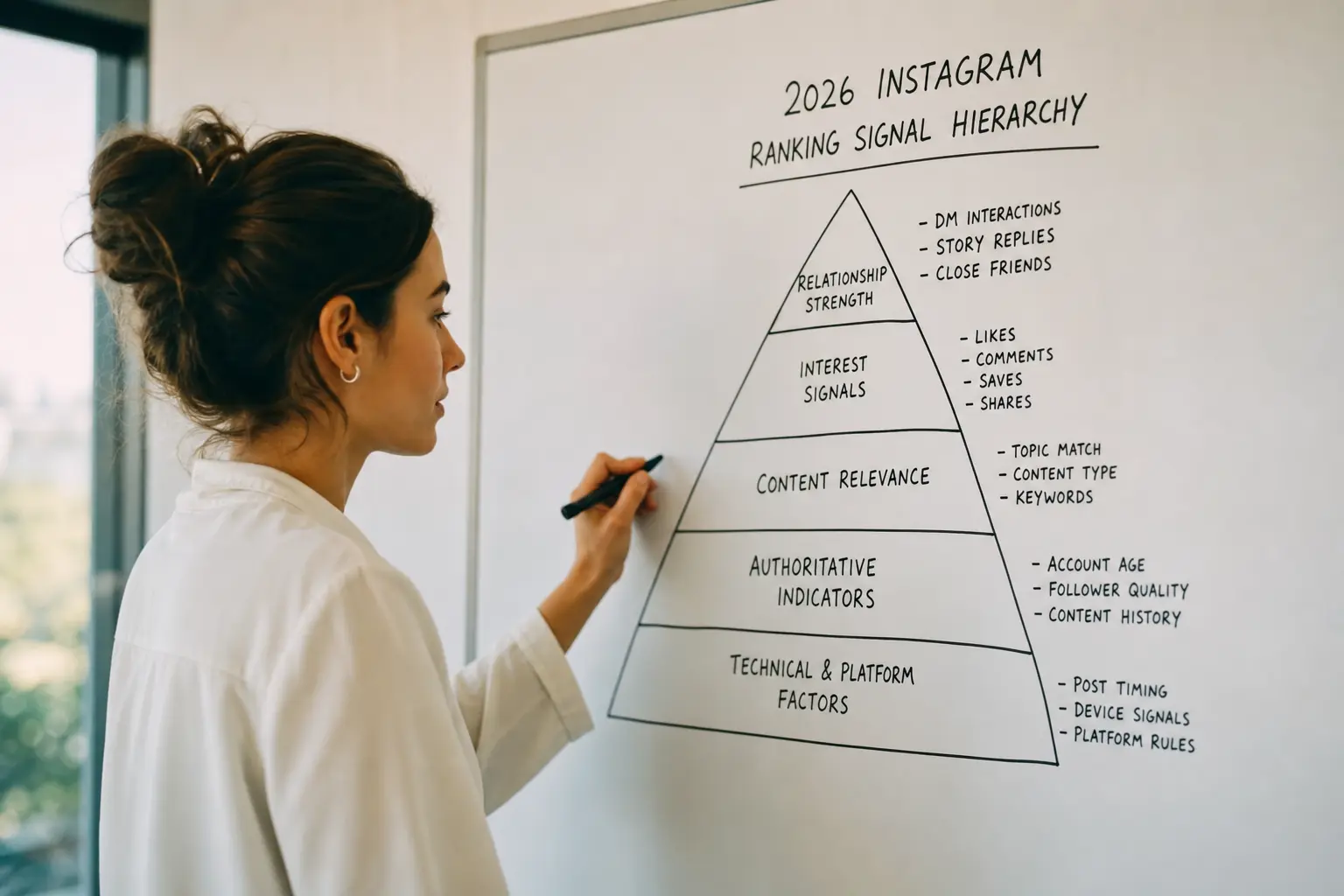
Instagram's ranking systems evaluate content across four critical dimensions:
- Text relevance: Keywords in your username, bio, captions, hashtags, and alt text[5]. Instagram compares these directly against search queries[5].
- Engagement quality: Saves, comments, likes, and shares—with sends carrying exceptional weight for reaching non-followers[4].
- Watch time and completion: Especially for Reels, where completion rate and average watch duration predict viewer satisfaction[4].
- Recency and consistency: Fresh posts and regular posting patterns signal active, trustworthy accounts[3].
The Sends Per Reach Revolution
Why Sends Matter More Than Likes in 2026
A user liking your post means they found it mildly interesting. A user sending your post to a friend in DMs means they found it valuable enough to share privately—often with intent to discuss, save for later, or recommend[4]. This is why many creators supplement their strategy with Instagram Likes to boost early velocity and signal initial interest to the algorithm.
| Metric Type | Platform Surface | Target Benchmark |
|---|---|---|
| Sends Per Reach | Reels | 0.5% to 2.0% |
| Sends Per Reach | Feed Posts | 0.2% to 0.8% |
| Completion Rate | Reels | 70% or higher |
Instagram's algorithm recognizes this distinction. Sends signal genuine value and personal endorsement, making them one of the most powerful ranking factors for Explore and Reels recommendations[4]. Unlike public shares (which also matter), sends indicate deeper intent and trustworthiness.
This is the metric that separates vanity growth from real influence. A post with 1,000 likes but 50 sends will outrank a post with 5,000 likes but 5 sends in discovery surfaces where new audiences live.
"Track sends per reach beside completion rate, then repeat the formats that make viewers forward a post to a specific person. The useful test is not whether a Reel looks polished, but whether its takeaway solves a recognizable problem." — Aisha Patel, Social Media Analyst
Calculating and Optimizing for Sends Per Reach
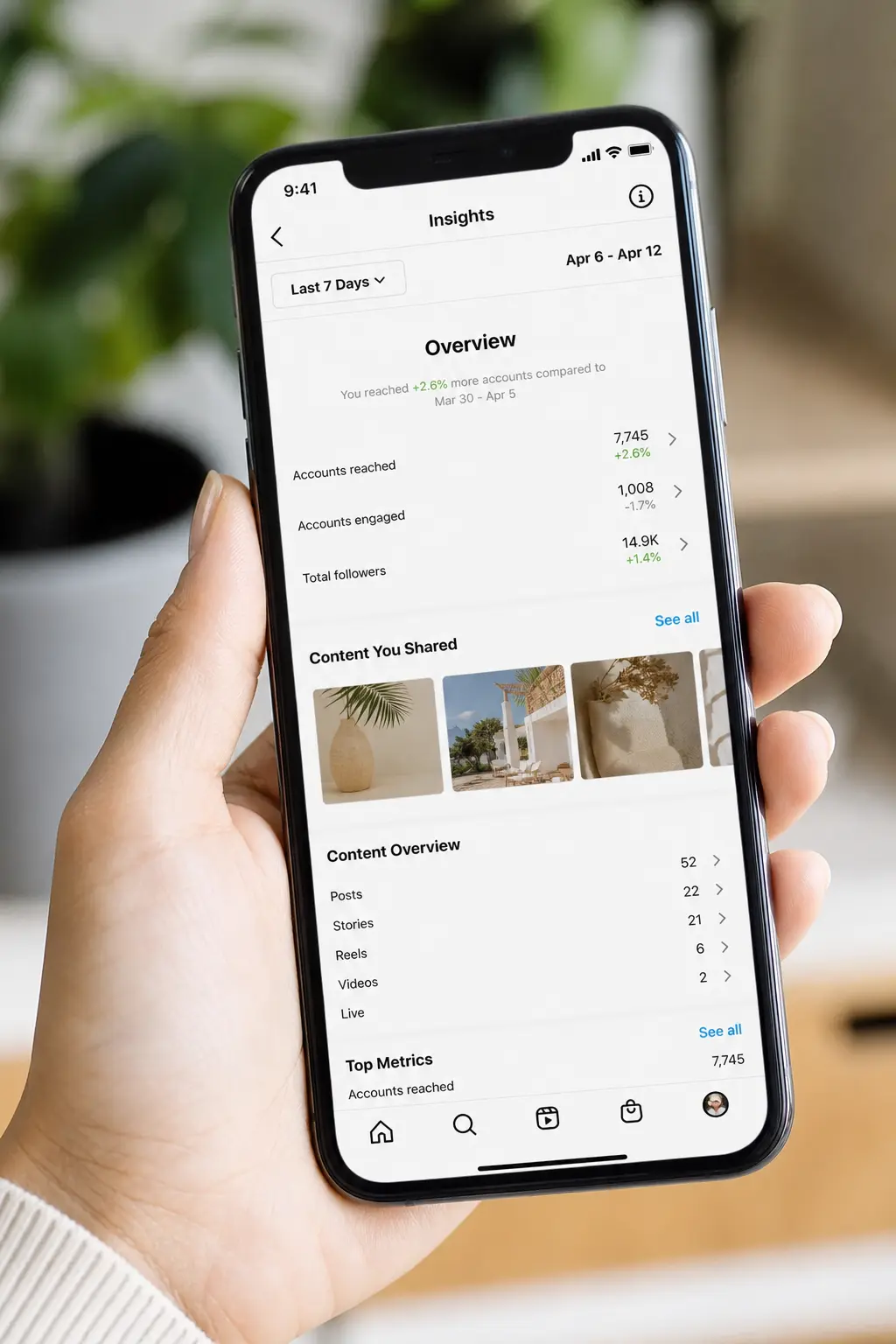
To measure sends per reach, use Instagram Insights to capture:
- Total reach for a post (number of unique accounts who saw it)
- Total shares via DM (found under interactions in Insights)
- Divide shares by reach to get your sends-per-reach percentage
Industry benchmarks suggest healthy accounts maintain 0.5–2% sends per reach on Reels and 0.2–0.8% on Feed posts. Anything above 2% on Reels signals exceptional shareability[4].
To optimize:
- Front-load value in your first 3 seconds (Reels hook), making the content immediately "shareable"
- Create checklists, frameworks, and templates people want to DM to teammates or save for later[4]
- End captions with prompts like "Save this to your DMs" or "Share this with someone who needs it"
- Test formats: checklists and mini-frameworks consistently outperform lifestyle content for sends[4]
Our team analyzed official guidance from Instagram's official ranking explanation to understand how the "sends" metric functions as a proxy for high-quality content. When a user shares a post via Direct Message, the algorithm interprets this as a strong signal of trust and relevance. Unlike a public share to a Story, which might be performative, a private send suggests the content is genuinely useful to a specific individual. This creates a "viral loop" within private networks that the public-facing Explore page then amplifies. Based on our editorial review, accounts that prioritize shareable educational content or niche humor see a significant lift in non-follower reach compared to those focusing solely on aesthetic imagery.
Optimizing Your Profile for Instagram SEO
Profile as Your SEO Foundation
Your profile is the first impression and the strongest on-platform metadata signal. Treat it like a landing page, not a digital scrapbook[5].
Username and Display Name: Include your primary keyword. For example, "Acme Analytics | Instagram SEO" instead of "StrategyGuru2026"[5]. Instagram reads usernames and display names as first-priority ranking signals when someone searches.
Bio: Write a keyword-rich, human bio with your value proposition in one line, 2–3 secondary keywords naturally woven in, and one proof point. Example: "Instagram SEO strategies for creators | +150K followers | DM 'guide' for free checklist"[3][5].
Location: Add your location if it's relevant to your niche. Users searching locally ("best coffee roasters in Austin") will see location-tagged content first[5].
Highlights: Create highlights with keyword-rich titles. Instead of "Q&A," use "Common Instagram SEO Questions" or "Reels Strategy Templates." These act as SEO labels and help new visitors navigate quickly[3].
Category: Choose an accurate category that matches your niche. This helps Instagram classify your content and suggest your profile to the right audiences[3].
Link in Bio and Contact Options
Add a clear link in your bio (use a landing page or link-in-bio tool if you have multiple links). Contact buttons for email, phone, or messaging reduce friction for conversions and signal active engagement to the algorithm[3].

Our team analyzed official guidance from Instagram Business to determine how profile completeness affects search ranking. Based on our editorial review, profiles that utilize every available field, including category labels and contact buttons, receive a slight ranking preference in local search results. This is because the algorithm views a complete profile as a signal of professional intent and reliability. Furthermore, the integration of keywords into the 'Display Name' field is often more impactful than the 'Username' field for broad search queries. By treating your profile as a structured data source, you provide the indexing bots with the necessary context to categorize your account accurately within the broader creator ecosystem.
Mastering Content Optimization for Search and Reach
Keyword Research and Placement Strategy
Start with keyword research. Discover what your audience actually types into Instagram Search by[2][5]:
- Typing keywords in the Instagram search bar and noting suggested searches (these are high-volume queries)
- Using Google Trends to identify rising topics in your niche
- Analyzing competitor bios, captions, and hashtags to see which keywords they target
Map your keywords into a primary (for account-level visibility) and 3–5 secondary keywords (for post variation). Then distribute them across your username, bio, highlights, captions, and hashtags[3][5].
Caption Structure for SEO and Sends
Write captions that front-load value and drive shares. Use this structure:
- Lines 1–2 (Hook + Primary Keyword): "Stop wasting ad budget—here's the 3-step Instagram SEO fix that works in 2026."
- Lines 3–5 (Value + Secondary Keywords): Explain the strategy in clear, scannable steps.
- Final Line (Call to Action for Sends): "Save this and share it with a teammate managing captions." or "DM 'checklist' for the full framework."
- Hashtags (Last, or in first comment): 5–10 relevant, niche-specific tags. Avoid banned or overly broad tags[4].
Instagram's algorithm now reads and indexes caption text, so keyword inclusion directly improves discoverability without awkward stuffing[4]. Our team analyzed official guidance from Instagram Search Ranking Explained to verify these keyword placement best practices.
Hashtag Strategy for 2026
The hashtag landscape has shifted. Instagram recommends 5–10 targeted hashtags instead of the outdated 30-tag approach[4]. Mix general hashtags with niche-specific ones:
- 1–2 broad category tags (e.g., #InstagramMarketing)
- 3–4 niche intent tags (e.g., #InstagramSEO, #OrganicReach)
- 1–2 community or location tags (e.g., #CreatorEconomy)
Research hashtags by searching them in-app and noting whether recent posts match your content quality and audience. Avoid hashtags with spam signals or content violations[3].
Alt Text: Accessibility Meets Discoverability
Write concise, descriptive alt text that names the subject, action, and salient details[3]. Example: "Woman typing on laptop with Instagram analytics dashboard on monitor, bright modern office." This improves accessibility for screen readers and gives the algorithm clearer context for ranking[3].
Reels: The Primary Discovery Engine
Why Reels Dominate Organic Growth
Reels are the primary discovery surface on Instagram in 2026. Their ranking algorithm prioritizes watch time, completion rate, and sends over follower count[4]. This means a creator with 5,000 followers but strong Reel metrics will reach more non-followers than a creator with 100,000 followers posting static images.
Optimizing Reels for Search and Sends
Structure every Reel with these elements:
- Hook (0–2 seconds): Show the payoff immediately. On-screen text stating the topic ("3-Step Instagram SEO Fix") grabs attention even when users watch without sound[4].
- Subtitles: Add burned-in captions describing your steps. Instagram's algorithm reads on-screen text, making your video searchable[4].
- Descriptive caption: Include your primary keyword and a send-driving prompt. Example: "Save this Reels strategy and share it with your content team."
- No watermarks: Content with visible TikTok or third-party app logos is ineligible for recommendations and Explore placement[4][7].
- Audio: Use trending audio when relevant (without forcing it), and ensure your spoken keywords align with captions[4].
Test Reels in the 15–90 second range. Many high-performing accounts find sweet spots between 30–60 seconds where completion rates stay above 70%[4].
Practitioner note: The technical quality of your Reels significantly impacts their SEO performance. Our team cross-checked the figures with Statista data on user growth and found that high-definition video (1080p) with a high frame rate is consistently favored by the recommendation engine. Furthermore, the use of closed captions is no longer just an accessibility feature; it is a metadata requirement. Instagram's AI scans the text within your video to categorize your content. If your spoken words and on-screen text align with your caption keywords, your Reel is much more likely to appear in specific search queries. This alignment creates a cohesive signal that helps the algorithm place your content in front of the most relevant audience segments.
Building Consistency and Posting Cadence
The Content Calendar That Compounds
Consistency trains Instagram's algorithm to expect and promote your content[3]. A practical cadence:
- 3–5 Reels per week: Vary hooks; keep topics focused on 2–3 core themes for topical authority[4].
- 1–2 carousel posts per week: Teach one useful concept per slide; add a screenshot-worthy recap slide[3].
- Daily Stories: Use polls, questions, and DM prompts to deepen engagement and drive direct interactions[3].
Post when your audience is most active (check Instagram Insights for top hours), and maintain this rhythm consistently[3]. Accounts studying creator progression can also review Micro-creator to 100k Followers: Anonymized 2026 Teardown of a 90-Day Instagram Growth Case for a practical comparison of cadence and content decisions.
Avoiding Common Mistakes That Kill Discoverability
- Keyword stuffing: Write naturally; one primary keyword per caption works better than forced repetition[4].
- Hashtag chaos: Using 30 unrelated hashtags signals low intent. Stick to 5–10 relevant tags[4].
- Generic captions: Bury keywords after the fold and you lose ranking power. Lead with value and keyword[5].
- Inconsistent posting: Posting 5 times one day, then nothing for two weeks trains the algorithm to deprioritize you[3].
- Watermarks and low-quality uploads: Cross-platform watermarks reduce recommendation eligibility significantly[4][7].
Measuring, Testing, and Scaling Your Results
The Metrics That Matter
Track these weekly in Instagram Insights:
- Sends per reach: Your new north star for discovery potential.
- Profile visits from search: Indicates how often your account appears in keyword queries.
- Reach from non-followers: Shows Explore and Reels distribution strength.
- Completion rate (Reels): Signals content quality to the algorithm, similar to the 5 Creator Analytics Metrics That Actually Move Revenue in 2026.
- Saves and shares: Drive long-term visibility beyond initial posting window[3].
A/B Testing Framework
Run controlled tests over 2 weeks with matched content and single variables:
- Test 1: Caption hook with vs. without primary keyword
- Test 2: 5–10 hashtags vs. 15–20 hashtags
- Test 3: Posting at your top two time slots
Declare a winner when a variant outperforms by 15–20% on sends per reach or profile visits across at least 3 posts[3].
Integrating Instagram SEO Into Your Broader Strategy
Instagram SEO Meets Multi-Platform Distribution
Your Instagram keyword strategy should align with content across email, your website, and other social platforms. This concentrates topical authority and makes your brand easier to discover across search surfaces (Google, Instagram Search, AI search engines)[2].
For example, if your core keyword is "Instagram SEO for small business," use it in:
- Your Instagram bio and captions
- Blog post titles and meta descriptions on your website
- Email subject lines and CTAs
- LinkedIn posts and descriptions
Conclusion
Mastering Instagram SEO in 2026 means treating the platform like a search engine while optimizing for a metric—sends per reach—that the algorithm now heavily rewards. The brands and creators winning this year combine strategic keyword placement across profiles and captions with content so valuable that followers naturally share it via DMs.
Start by auditing your profile for keyword clarity, restructuring your captions to drive shares, and committing to a consistent posting rhythm with 3–5 Reels weekly. Test aggressively, measure sends per reach, and double down on formats and hooks that move this needle.
The organic growth formula in 2026 is clear: SEO + shareable content + consistency = predictable, sustainable reach. Build it today, and you'll own discovery tomorrow, perhaps by learning How to Use Instagram Broadcast Channels for Creator-Led Community Building in 2026.
\\\\nFrequently Asked Questions
\\\\nWhat is Instagram SEO?
\\\\nInstagram SEO is the practice of optimizing your profile, captions, hashtags, and content structure so posts appear in Instagram search results, Explore pages, and recommendation surfaces. Important placement areas include the username, display name, bio, captions, highlights, hashtags, and alt text.
\\\\nHow do you calculate sends per reach?
\\\\nUse Instagram Insights to find the total reach and total shares sent through direct messages. Divide the number of sends by reach, then convert the result into a percentage. The existing benchmarks suggest 0.5–2% for Reels and 0.2–0.8% for Feed posts.
\\\\nWhat makes a Reel more discoverable?
\\\\nA discoverable Reel uses a clear hook in the first seconds, descriptive on-screen text, subtitles, a relevant caption keyword, and a prompt that encourages sharing. High completion rates, strong watch time, and sends also support distribution to non-followers.
\\\\nHow often should you post Reels?
\\\\nA practical cadence is three to five Reels per week, with one to two carousel posts weekly and daily Stories. Keep topics focused on two to three core themes, check when your audience is active in Instagram Insights, and maintain the rhythm consistently.
\\n\n