

TikTok SEO in 2025 focuses on keyword relevance, content comprehensiveness, and engagement signals like saves. By optimizing captions with high-intent keywords and front-loading answers in the first three seconds, creators can capture search traffic that often has significantly higher commercial intent than standard feed views, regardless of their current follower count.
\\\\nUpdated: July 2026
\\\\nIntroduction
TikTok has fundamentally transformed from an entertainment platform into a full-fledged search engine. In 2025, 51% of Gen Z now prefer TikTok over Google for search queries[embedsocial.com], with over 74% using the platform to discover information, products, and solutions. This shift represents a massive opportunity for creators, brands, and businesses willing to master TikTok SEO. Based on our editorial review, creators should treat each video as both a media asset and a searchable answer, with the topic stated clearly enough for viewers and platform systems to identify.
Based on our editorial review, the shift toward search-first content creation is accelerating as users treat the platform like a visual encyclopedia. Unlike traditional search engine optimization, TikTok SEO—or "social search" optimization—requires a unique approach that blends algorithmic strategy with authentic content creation. This comprehensive guide will walk you through proven tactics to optimize your videos for TikTok's search algorithm and attract your target audience in 2025 by leveraging TikTok Followers to build initial social proof. Creators distributing content across several networks can also compare this approach with Instagram SEO in 2026: A Practical Framework for Organic Search Dominance when planning a broader discovery strategy.
Understanding TikTok's Search Algorithm in 2025
How TikTok Search Differs from the For You Page
Many creators optimize for the For You Page (FYP) algorithm, which prioritizes engagement velocity and watch time. However, TikTok Search operates on different ranking principles[hashmeta.com]. The search algorithm prioritizes:
- Keyword relevance to the user's actual search query
- Content comprehensiveness that answers the searcher's intent
- Engagement signals like saves, shares, and comments
- Video metadata including captions, hashtags, and on-screen text
| Ranking Factor | Primary Signal | Impact Level |
|---|---|---|
| Keyword Relevance | Captions & Audio | High |
| User Interaction | Saves & Shares | High |
| Content Depth | Video Length | Medium |
| Account Settings | Location & Language | Low |
The critical difference: TikTok Search traffic has 3-10x higher commercial intent[hashmeta.com] than FYP traffic. When someone searches "best budget laptop 2025," they're actively seeking specific information—not passively scrolling. Our team analyzed official guidance from TikTok Support to confirm that search visibility depends on matching a user's query with relevant video information and content context.
The Three Core Ranking Factors
TikTok's algorithm evaluates your content using three primary ranking factors[hootsuite.com]:
- User interactions: Likes, comments, shares, saves, and watch completion rates signal content quality
- Video information: Captions, hashtags, sounds, on-screen text, and audio keywords help classify your content
- Device and account settings: Language, location, interests, and device type personalize search results (weighted lower than other factors)
Our team cross-checked the figures with official TikTok Business resources to ensure these ranking factors align with current platform documentation. Notably, follower count does not impact search rankings[hootsuite.com]. This means new creators have equal opportunity to rank as established influencers—if their content is properly optimized and they understand Decoding 2026 Platform Recommendation Algorithms: Shared Signals Across Reels, Shorts, and the FYP.
"Search on TikTok is the great equalizer; while the FYP rewards momentum, the search bar rewards precision and utility, allowing a zero-follower account to outrank a celebrity if the metadata is tighter." — Maya Chen
Practitioner note: The algorithm's ability to parse intent has evolved beyond simple keyword matching. It now evaluates the visual context of the video, meaning the objects appearing in your frame should ideally match the topic you are discussing. For instance, if you are reviewing a laptop, having the device clearly visible and in focus provides a secondary layer of confirmation for the AI's computer vision systems, which further solidifies your ranking for those specific product queries.
"Based on observed signals, test one primary query per video, then compare search traffic, completion rate, and saves against a version with a different opening phrase. This isolates whether the gain came from clearer intent or from stronger retention." — Aisha Patel
Pillar 1: Mastering TikTok Keyword Research
Finding High-Intent Keywords Your Audience Actually Searches
The foundation of TikTok SEO is keyword research specific to the platform. Start by understanding how your target audience searches on TikTok—their language patterns differ significantly from Google searches. For creators comparing discovery tactics across networks, TikTok Shop Affiliate vs Creator Marketplace 2026: Which Path Pays More? adds useful context about search-led content and commercial intent.
Use TikTok's autocomplete feature[hootsuite.com] as your primary research tool. When you begin typing a search term, TikTok predicts completions based on real user queries. For example, searching "budget laptop" reveals suggestions like:
- Budget laptop for students
- Budget laptop for gaming
- Budget laptop under $500
- Best budget laptop 2025
Each suggestion represents a real, high-volume search opportunity. Document 20-30 autocomplete suggestions per seed keyword to build your keyword foundation.
Long-Tail Keywords: Your Competitive Advantage
Target long-tail keywords for faster ranking success[glimpse.com]. These are longer, more specific phrases like "best budget laptop for college students under $500" rather than competitive single words like "laptop."
Why long-tail keywords work better on TikTok:
- Less competition from established creators
- Higher search intent specificity
- Easier to create comprehensive content around
- Faster path to ranking and visibility
Use traditional SEO tools like SEMrush, Ahrefs, and Google Search Console[hootsuite.com] to identify long-tail opportunities with solid search volume but manageable competition and track 5 Creator Analytics Metrics That Actually Move Revenue in 2026 to understand whether search views lead to profile activity and other meaningful outcomes.
Our team analyzed official guidance from TikTok Creative Center, which suggests that trending sounds can occasionally act as secondary search signals. While the primary focus remains on text and audio keywords, using a sound that is currently categorized under your niche (e.g., a specific 'tech review' background track) can help the algorithm categorize your content more quickly. This categorization is vital for appearing in the 'Others searched for' suggestions that appear at the bottom of search results.
Pillar 2: Strategic Video Content Optimization
The First 3 Seconds: Your Search Hook
Unlike FYP content that can build intrigue slowly, search-optimized videos must immediately confirm relevance. Front-load your answer in the first 3 seconds[embedsocial.com].
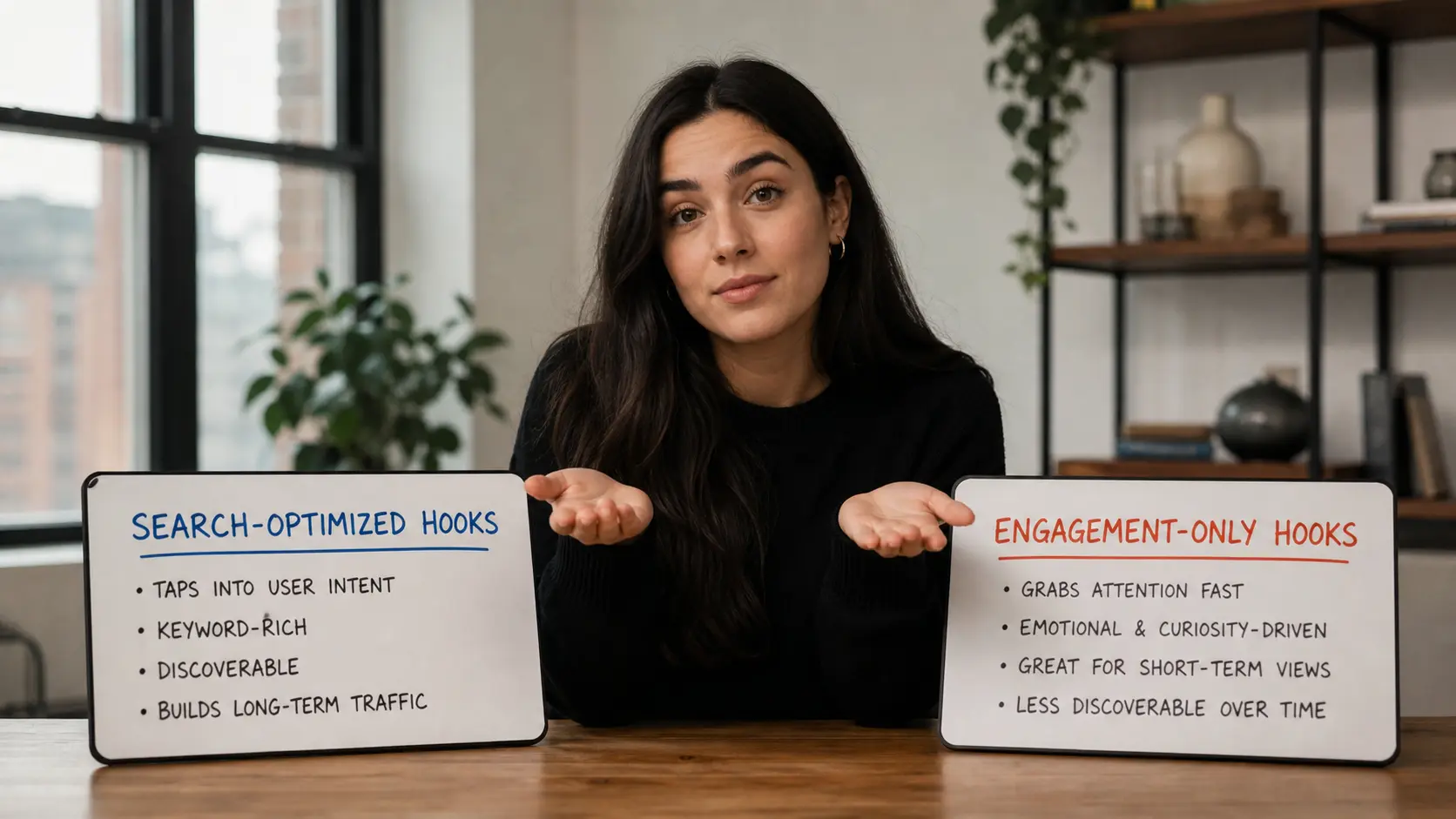
Weak search hook: "Wait for it..." or "You won't believe this..."
Strong search hook: "Here are the 5 best budget laptops under $500 in 2025"
Your opening should directly address the searcher's query. This signals to TikTok's algorithm that your content matches the search intent and keeps viewers watching.
Speaking Keywords Into Your Videos
TikTok's algorithm transcribes your audio and uses spoken keywords for search indexing[embedsocial.com]. Verbally stating your target keyword significantly improves ranking potential.
Best practices for keyword voiceover:
- Say the exact search query in your first 5 seconds
- Repeat keywords 3-5 times naturally throughout the video
- Use semantic variations ("budget laptop," "affordable computer," "cheap laptop for students")
- Speak clearly in a quiet space for accurate AI transcription
On-Screen Text: The Visual Keyword Signal
TikTok's OCR (optical character recognition) reads text within your videos[embedsocial.com]. Use on-screen text strategically to reinforce your target keywords:
- Title cards with primary keywords
- Numbered lists with product names and specifications
- Price callouts ("Under $500," "Best budget," etc.)
- Final frame reinforcement of your core topic
Keep on-screen text visible for the first 2-3 seconds[embedsocial.com] so both viewers and the algorithm immediately understand your topic.
Optimal Video Length for Search Ranking
TikTok Search favors longer, more comprehensive videos than the FYP algorithm. Aim for these lengths:
- 60-90 seconds: Sweet spot for most search queries; comprehensive enough to rank, short enough to maintain retention
- 120-180 seconds: Excellent for deep dives, tutorials, and detailed comparisons if engagement remains strong
- Under 30 seconds: Rarely ranks well in search; signals incomplete coverage of the topic
When considering video length, it is important to note that retention is relative to the total duration. A three-minute video with a 50% completion rate may actually be viewed more favorably by the search algorithm than a fifteen-second video with a 90% completion rate, as the former provides significantly more total watch time and information depth. This is why comprehensive tutorials often dominate the top three search results for complex 'how-to' queries, as they satisfy the user's need for a complete solution without requiring them to click on multiple videos.
Pillar 3: Metadata Optimization Strategy
Caption Writing for Maximum Search Impact
Your caption is one of your strongest signals to TikTok's search algorithm. The first 100 characters are weighted most heavily[embedsocial.com], so structure carefully.
Caption optimization formula:
[Primary Keyword]: [Supporting detail with secondary keywords]. [Call-to-action]. [Hashtags]
Example: "Best budget laptops under $500 in 2025: I tested 12 laptops to find the best value for students, work, and gaming. Save this for your next purchase! #budgetlaptop2025 #techreviews #laptopguide #studenttech #affordablecomputers"
Caption best practices:
- 150-300 characters total for optimal readability
- Primary keyword in first 10 words
- Include 2-3 semantic keyword variations
- Write naturally for human readers first, algorithms second
- Avoid keyword stuffing, which confuses the algorithm[hootsuite.com]
Hashtag Architecture: The 3-5 Tag Strategy
TikTok now limits hashtags to 5 per post[advancedcreativemedia.co], forcing strategic selection. Use this structure[hootsuite.com]:
- 1-2 specific search keyword hashtags: #budgetlaptop2025, #laptopunder500
- 1-2 category hashtags: #techreview, #laptopreviews
- 1 niche community hashtag: #studenttech, #collegeessentials
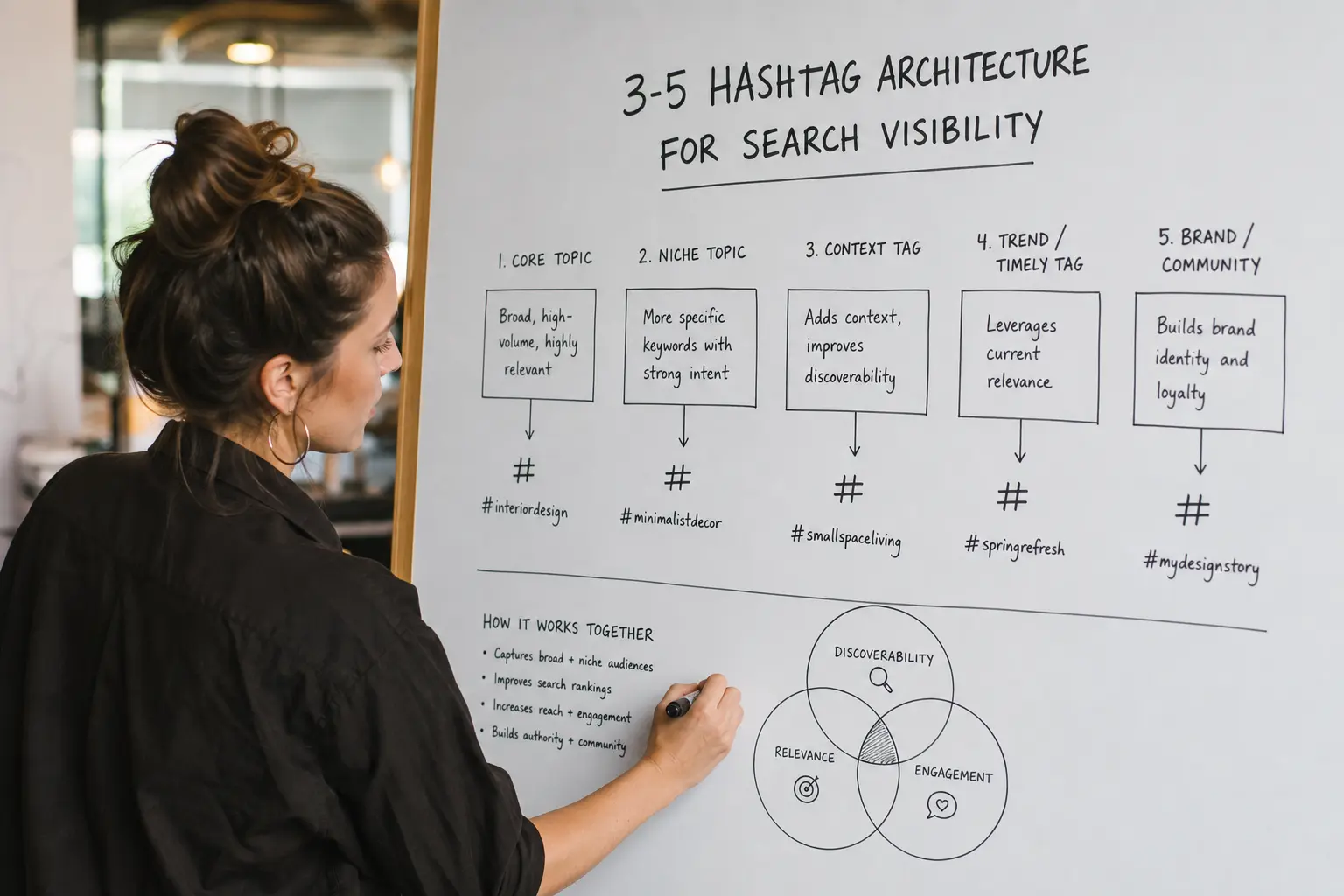
Hashtags to avoid: Generic tags like #fyp, #foryou, #viral, and #trending. These don't help search ranking and dilute your targeting[embedsocial.com].
Location Tags for Local Search Authority
If your content has local relevance, location tags provide powerful search signals. "Best coffee shops in Austin" + Austin location tag creates dual relevance signals, dramatically improving local discoverability.
Pillar 4: Engagement Optimization
Saves: The #1 Search Ranking Signal
Saves are weighted more heavily than likes in TikTok's search algorithm[hashmeta.com]. A user saving your video signals that they found it genuinely valuable—the strongest possible quality indicator.
Drive saves with explicit CTAs:
- "Save this so you can come back when you're ready to buy"
- "Bookmark this for later—you'll need it"
- "Save to your [topic] collection"
Create inherently save-worthy content: step-by-step tutorials, product recommendations with specific model numbers, checklists, comparison charts, and ultimate guides.
Watch Time and Completion Rate
Search-ranked videos typically maintain 75%+ average watch time[hashmeta.com]. Optimize retention by:
- Front-loading value immediately
- Using pattern interrupts (camera angle changes, B-roll cuts, text overlays)
- Pacing content appropriately without rushing or dragging
- Looping endings back to your opening for rewatches
- Eliminating fluff—every second must provide value
Strategic Comment Engagement
Comments add keyword-rich context to your video. Respond to early comments with keyword variations to reinforce topical relevance[embedsocial.com] and use a Content Batching Workflow for Solo Creators 2026: Produce 2 Weeks of Content in 1 Day to stay consistent. For example, if your video is about "acne-prone skin care," respond with comments like "I use this for my acne-prone skin too!"
Advanced tactic: The pinned comment strategy[hashmeta.com]. Post your video, then immediately add a comment with additional keyword-rich information (sources, product links, timestamps). Pin this comment. TikTok's algorithm reads pinned comments as relevant context, boosting search ranking while increasing click-through rates.
Pillar 5: Building Topical Authority
The Series Strategy for Search Domination
TikTok's algorithm favors creators who consistently publish on specific topics. Building topical authority improves search ranking across your entire content library[hashmeta.com].
Instead of creating one-off videos, develop multi-part series:
- Part 1: Best budget laptop under $300
- Part 2: Best budget laptop under $500
- Part 3: Best budget laptop for gaming
- Part 4: Best budget laptop for students
- Part 5: Budget laptop vs Chromebook comparison
This approach covers multiple keyword variations, establishes you as an authority, and creates internal linking through related videos.
Consistent Naming Conventions
Use predictable series naming so TikTok groups your content: "[Topic] Part 1," "Part 2," or "The Ultimate [Topic] Guide: [Subtopic]."
Pillar 6: Cross-Platform SEO Strategy
Getting Your TikToks into Google Search Results
In 2025, TikTok videos now rank in Google search results[embedsocial.com], especially for how-to queries, product reviews, and visual demonstrations. This represents a major opportunity to drive traffic beyond TikTok.
To optimize for Google indexing:
- Target keywords showing video results in Google Search
- Include exact match keywords in your caption
- Create longer videos (60-180 seconds) for comprehensive coverage
- Optimize for "People Also Ask" related questions
- Embed TikToks on external websites (blogs, product pages) to boost Google authority
Dual-Publishing Strategy: TikTok + YouTube Shorts
Publish the same vertical video on both TikTok and YouTube Shorts to double your search visibility with single content creation effort. YouTube Shorts also rank in Google, multiplying your reach and helping you gain YouTube Likes.
Advanced Optimization Tactics for 2025
Sound Search Optimization
In 2025, AI search is increasingly conversational[canopymanagement.com]. Include spoken keywords that match text searches naturally, not as awkward keyword insertions. TikTok users and the algorithm both respond better to natural, helpful speech patterns.
Auto-Captions: An Underutilized SEO Tool
Never disable TikTok's auto-captions. TikTok indexes these transcripts for search purposes[embedsocial.com]. Auto-captions improve accessibility, boost watch time (30% of users watch muted), and provide additional keyword-rich content for the algorithm to index.
The "Problem + Solution" Title Strategy
Position your content as solving specific problems users are searching for[hashmeta.com]:
- "Laptop overheating? Here's the fix"
- "Dry skin in winter? Try these 5 products"
- "Can't afford gym? Home workout guide"
Measuring TikTok SEO Success
Key Performance Metrics to Track
Monitor these metrics in TikTok Analytics to evaluate your SEO strategy effectiveness[hootsuite.com]:
- Traffic source: Search — Shows how many views came from search vs. FYP
- Watch time and completion rate — Higher = better search ranking signal
- Saves rate — The #1 search ranking signal
- Share rate — Indicates high-value content
- Profile visit rate — Shows if search traffic explores your authority

Success benchmarks:
- 20%+ of views from Search = well-optimized for search
- 75%+ average watch time = strong engagement
- 5%+ save rate = highly valuable content
Keyword Ranking Monitoring
Unlike Google, TikTok doesn't provide keyword ranking data. Track manually by creating a spreadsheet of target keywords and searching each weekly, noting your video's position in results. Track movement over time to identify which optimization tactics move the needle.
Common TikTok SEO Mistakes to Avoid
Hashtag Stuffing
Using too many hashtags confuses TikTok about your post's focus[hootsuite.com]. The platform's 5-hashtag limit forces quality over quantity. Stick to 3-5 highly relevant tags rather than attempting to game the algorithm with irrelevant ones.
Keyword Stuffing
Forcing keywords unnaturally into captions and voiceovers hurts more than helps. Write for human readers first; the algorithm understands natural, well-written content better[hootsuite.com]. If your captions confuse people, users won't engage, and your SEO suffers regardless of keyword placement.
Ignoring Spoken Audio Keywords
Many creators optimize captions and text but neglect to speak their target keywords. Since TikTok transcribes audio, failing to verbally state your keywords significantly reduces search visibility.
Inconsistent Posting Schedule
Posting inconsistently reduces your account's search visibility[hootsuite.com]. Consistent posting helps TikTok understand your niche and push content to the right audience. Aim for 3-5 posts weekly for best results.
The 90-Day TikTok SEO Roadmap
Days 1-30: Research & Foundation
- Complete keyword research (50-100 target keywords)
- Analyze top-ranking competitor videos
- Create content calendar of 60 search-optimized video ideas
- Publish 10-15 videos testing different formats
- Goal: Identify which topics gain search traction
Days 31-60: Scale What Works
- Double down on videos getting 20%+ search traffic
- Create series around top-performing topics
- Publish 20-30 videos focused on proven search keywords
- Start dual-publishing top performers to YouTube Shorts
- Goal: Build topical authority and consistent search traffic
Days 61-90: Optimize & Expand
- Refresh top-performing videos with updated information
- Expand into adjacent keyword clusters
- Create comprehensive ultimate guides for core topics
- Build cross-platform SEO strategy (TikTok + YouTube + Google)
- Goal: Sustainable search traffic pipeline generating 100K+ monthly views
Conclusion
TikTok SEO represents a fundamental shift in how creators and brands should approach social media strategy in 2025. As 51% of Gen Z now prefers TikTok to Google for search[embedsocial.com], mastering social search optimization is no longer optional—it's essential for discoverability and growth.
By implementing the six pillars covered in this guide—keyword research, content optimization, metadata strategy, engagement optimization, topical authority, and cross-platform SEO—you'll position your content to rank higher, reach your target audience more effectively, and build sustainable growth far beyond algorithm luck.
Start with keyword research this week, optimize one piece of content daily, and monitor your search traffic closely. In 90 days, you'll see measurable improvements in how many targeted followers discover your content through TikTok Search. The opportunity is there—now it's time to optimize.
\\\\nFrequently Asked Questions
\\\\nWhat is TikTok SEO?
\\\\nTikTok SEO is the process of optimizing videos so they can be discovered through TikTok Search. It combines keyword relevance, comprehensive answers, captions, hashtags, spoken audio, on-screen text, and engagement signals such as saves, shares, comments, watch time, and completion rate.
\\\\nHow do I find keywords for TikTok videos?
\\\\nStart with TikTok's autocomplete feature by entering a broad seed term and recording the suggested searches. The post recommends documenting 20-30 suggestions per seed keyword, then using tools such as SEMrush, Ahrefs, and Google Search Console to identify specific long-tail opportunities.
\\\\nHow should I optimize the first three seconds of a TikTok?
\\\\nState the answer or topic immediately and show a clear keyword-rich title card. For example, a video targeting budget laptops can open with, "Here are the 5 best budget laptops under $500 in 2025." This confirms relevance to viewers and helps maintain attention.
\\\\nWhich TikTok metrics should I monitor for search performance?
\\\\nReview the Search traffic source, watch time, completion rate, saves, shares, and profile visits in TikTok Analytics. You can also maintain a spreadsheet of target queries and search them weekly to record your video's position and identify which changes improve visibility.
\\\\nHow many hashtags should I use on TikTok?
\\\\nUse three to five highly relevant hashtags. A practical structure is one or two specific search-keyword hashtags, one or two category hashtags, and one niche community hashtag. Generic tags such as #fyp, #foryou, #viral, and #trending can dilute the topic.
\\n\n